
Johnson County Resident Lookup Coverage
A person search works best when each record answers one narrow question. JCAD can identify a taxable owner and parcel information. The County Clerk’s index can identify a party to a recorded instrument. The state voter portal can confirm an individual registration route. Local court systems can identify parties and case events. DSHS indexes can supply historical marriage, divorce, birth, or death leads. A business filing or license can show an affiliation. Each source has different access rules and none is a complete roster.
| Record | What it can confirm | Where | Access |
|---|---|---|---|
| JCAD parcel roll | Taxable owner, situs, mailing clue, legal description | JCAD eSearch | Free search; it does not list every household member |
| Recorded instruments | Grantor or grantee role, date, and legal property link | County Clerk OPR | Index is public-facing; images and certification can cost |
| Voter status | Individual status, VUID, precinct, districts | Texas voter portal | Free individual route; confidential data is excluded |
| County or district court | Party, case type, filing, hearing, and disposition | Odyssey and clerk offices | Some files or copies are restricted or fee-based |
| Vital indexes | Historical names, dates, and event places | DSHS and local custodians | Recent copies need eligibility and identity proof |
| Business or license profile | Filed role, credential, status, or address | SOSDirect or the issuing board | Fields vary and may be stale |
If the only starting point is an address, use the property record to distinguish the situs from the mailing address, then use the owner name as one spelling to test elsewhere. The by-street directory has the more detailed address workflow. If the starting point is a name, preserve suffixes, initials, former names, and the date each result was found.
Normalize a Johnson County Resident Name
Same-name results are common. Record the exact spelling first, then list initials, middle names, suffixes, married or former names, and plausible spelling variants. Search each form separately. A court index, deed index, or business filing may use a middle initial that a voter lookup omits. An older newspaper can use initials, a spouse’s name, or an abbreviation. Do not merge two results just because a surname and town match.
Build a short evidence line for every possible match: source, date accessed, name string, case or instrument number, address or county, and what the result does not establish. A recorded sale can show a legal transaction, not a present residence. A license profile can show a practice location, not a household. This simple log makes conflicts visible before one incorrect identity gets repeated across several searches.
Confirm Johnson County Resident Status
The Texas My Voter Portal provides three individual routes: VUID, a Texas driver-license or DPS PIN route, or first name, last name, county, and date of birth. For the name route, select Johnson County. The returned result can include registration status and polling-place or election information when available. It is useful only when the identity inputs already point to one person.
The voter record is not a substitute for proof of where a person lives. Texas Election Code sections 18.005 and 18.066 distinguish public list information from confidential fields and protected addresses. The statewide file requires an affidavit against commercial promotion, while the individual portal is designed for a person-specific check. Never post a VUID, date of birth, address, or other identifier taken from a query.
The official state form shows the name-plus-county-and-date route alongside the VUID and identification routes.
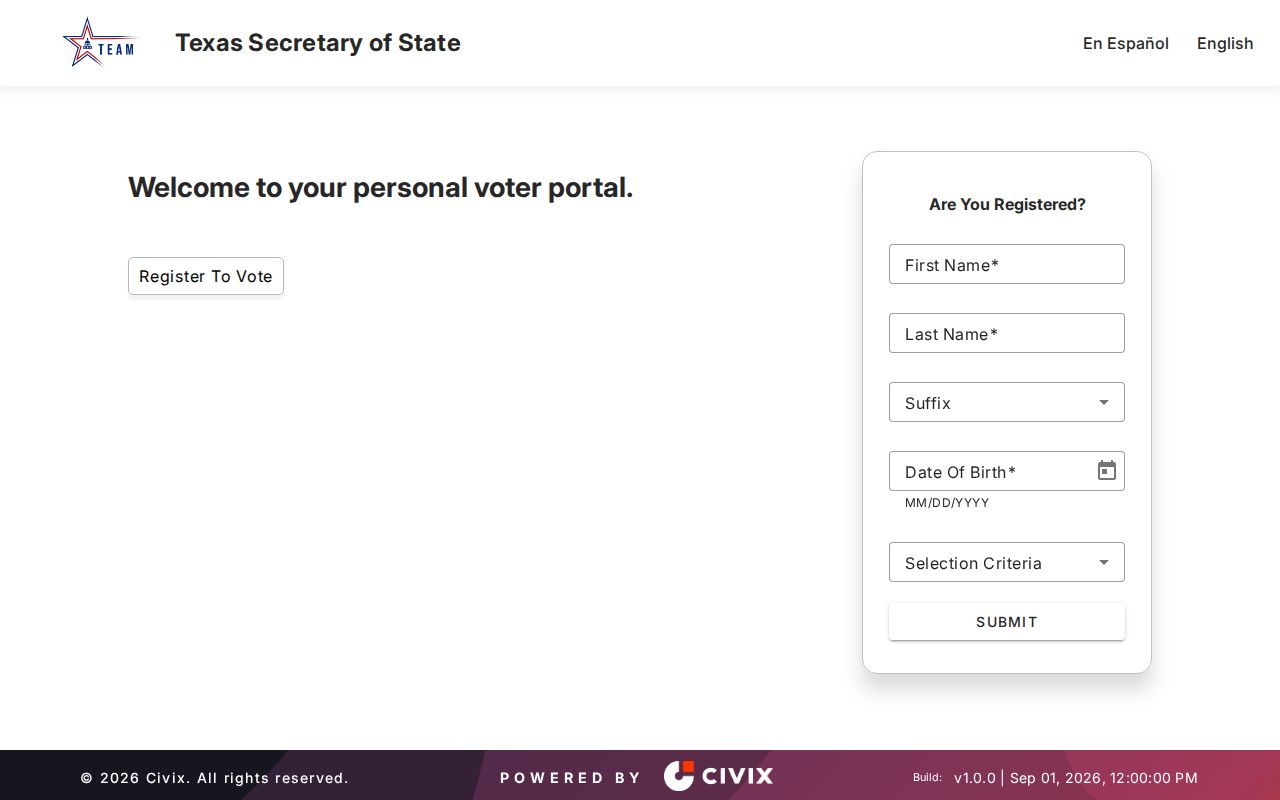
A protected voter may not have the expected public display. Treat that limit as a safeguard, not a reason to search around it.
Read Johnson County Resident Court Results
Odyssey Public Access routes Johnson County users to Criminal Records or Citation Payments, Civil & Probate Records, and Court Calendar paths. County Court at Law Nos. 1 and 2 handle county civil, family, probate, guardianship, criminal, juvenile, and collections matters. District court records use the District Clerk route. TAMES and re:SearchTX add statewide searching, but TAMES is refreshed nightly and is not a document repository.
A result can contain a case number, case type, parties, attorneys, hearing, filing, disposition, or document link. These are event markers. Confirm party role and date before treating a case as a lead on the right person. The local Odyssey research did not expose its full live field schema without a query, so local result columns and redactions should be visually verified before a reader relies on a particular display.
| Court result detail | Why it matters |
|---|---|
| Case number and type | Distinguishes one matter from another with the same party name. |
| Party role | Shows whether the name is a plaintiff, defendant, estate party, or another role. |
| Filing and hearing dates | Place the record in time and help compare it with another source. |
| Filings and documents | May lead to the custodian copy, subject to confidentiality and access rules. |
- Docket
- The court’s chronological list of filings, hearings, and other events in one case.
- Index versus image
- An index helps locate a file; an image is the underlying document and may have separate access or copy rules.
- Certified copy
- A copy issued by the custodian with a certification or seal when official proof is required.
Verify a Johnson County Resident Record
Verification means testing one candidate across records with independent purposes. Start with an owner, mailing, or situs clue in JCAD only if it fits the known name. Next, search the County Clerk index for a dated instrument and the court portal for a party role. Then test a vital index, obituary, directory, or newspaper against a date, spouse, parent, or event. Stop when the records conflict instead of filling the gap with an assumption.
- Write the candidate’s exact name, variants, address, county connection, and approximate dates.
- Use JCAD and the tax-office vocabulary to separate the property location from a mailing address, then capture the property or geographic ID and legal description.
- Search the party name in the deed and court indexes. Compare role, case or instrument number, date, and legal or county context.
- Use a voter result only where the individual inputs fit, then compare the status or precinct context with the other records.
- Check a DSHS index, local marriage record, obituary, newspaper, or directory for an event detail. Request the actual record from its custodian if proof is needed.
JCAD’s detailed property fields and a deed-chain method are described on the Johnson County by-street directory. The goal here is not to rebuild that parcel research, but to use one reliable property clue as a checkpoint in a one-person search.
Use Johnson County Vital Records
Texas DSHS Vital Statistics separates birth and death certificates from verification letters, and it separately offers marriage and divorce verifications. An index or verification can help locate an event. It is not a certified certificate, marriage license, or divorce decree. Recent requests require the proper relationship or eligibility, identity, event details, and payment.
Birth records generally open after 75 years and death records after 25 years under Texas Government Code section 552.115. DSHS marriage indexes begin in 1966 and divorce indexes in 1968. A certified marriage copy must come from the county where the license was purchased, while a certified divorce decree comes from the district clerk. Those distinctions prevent a searcher from ordering the wrong document.
The DSHS selection page displays the available certificate and verification request types.
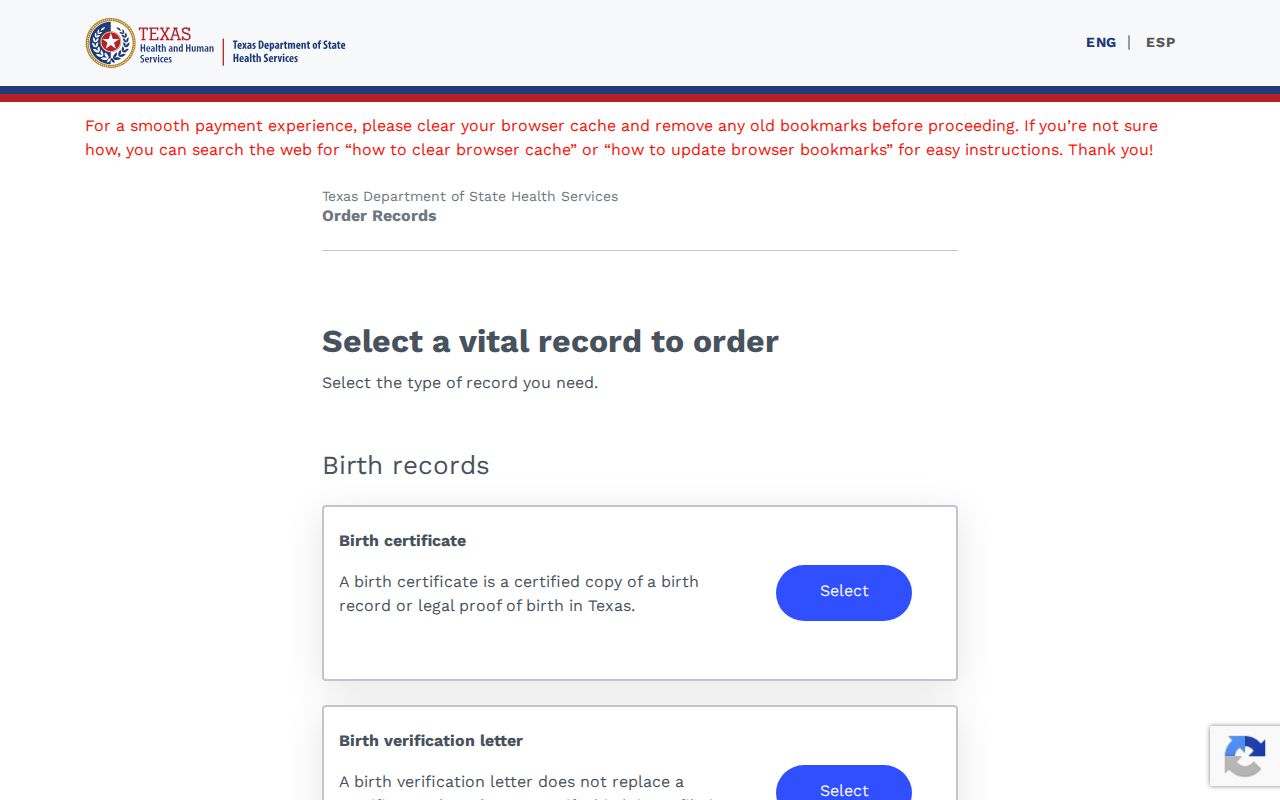
The order path begins with the record type. Eligibility and proof requirements determine whether a current certificate can be issued.
Find Johnson County Resident Heirs
Probate and guardianship records are the official starting route when an heir question is tied to a decedent. Search the decedent’s name and estate name in the county court path, then ask the County Clerk for the will, application, heirship material, service, or final orders that are publicly available. A probate file can identify heirs and mailing information, yet names can be incomplete or no longer current. Confirm the relationship with the custodian and another appropriate source.
For adoption-related reconnection, Texas DSHS runs the voluntary Central Adoption Registry. Adult adoptees, birth parents, and biological siblings may apply, and a match requires at least two qualifying people to register independently. The records are confidential under Family Code section 162.419. A general public-information request cannot open sealed identifying adoption material.
Human-use note. Probate, obituaries, yearbooks, cemetery research, and the voluntary adoption registry serve different family-history questions. Each needs its own evidence and privacy rules.
Confirm Johnson County Resident Affiliations
SOSDirect can search Texas entities, assumed names, UCC filings, registered agents, and filing histories. The County Clerk’s assumed-name records give a local business-name route. Texas professional boards can verify license status, issue or expiration dates, discipline, and, depending on the board, a profile or practice address. Use the official issuing source rather than a copied profile.
These results can corroborate a person’s filed role or professional affiliation. They do not prove a current home address or establish that the filer is the same person found in another record. SOSDirect requires an account and reports a one-dollar search fee, while document copies can have additional charges. Check the filing date and status before using it as a research lead.
Legal Limits for Johnson County Lookup
Texas public-record access has boundaries. The Texas Public Information Act does not override records made confidential by another statute. Protected voter and public-safety details, motor-vehicle information, recent vital certificates, juvenile and sealed court material, adoption records, and protected addresses have separate limits. The Texas Address Confidentiality Program gives qualifying victims a substitute address, and the true address is shared only through authorized legal channels.
The Texas Data Privacy and Security Act governs certain private-sector data rights but exempts government entities and regulated record types. It is not a way to delete an official deed, court record, voter record, or protected record. For a private data profile, use the company’s stated privacy request route, provide only necessary identification, save confirmation, and use the Attorney General complaint route for a covered controller that does not respond.
Lawful use. A Johnson County resident lookup is for personal, lawful research. Do not use information to stalk, harass, intimidate, dox, or expose a protected address.