
Johnson County City Directories: Verified Collections
Johnson County city-directory research has several solid starting points, but the surviving runs are uneven. The Texas State Library city-directory holdings verifies Cleburne volumes for 1921, 1938, and 1947. The UT Briscoe Center directory index identifies a longer Southwestern Bell telephone-directory trail for Cleburne and nearby Godley, Joshua, Keene, and Rio Vista. It is a catalog trail, so confirm an item’s availability before making a trip or treating a phone listing as proof that someone lived there.
The locally distinctive early evidence is a 1899-1900 Cleburne transcription in Finders Keepers, available through the Portal to Texas History. Newspapers, maps, census material, and microfilm help cover the spaces between printed books. The table separates what is verified from what still needs an in-person shelf check.
| Collection | Years | Where held | Access |
|---|---|---|---|
| Cleburne city-directory shelf | 1921, 1938, 1947 | Texas State Library | Confirm availability before travel |
| Cleburne-area telephone directories | 1908-2005, with gaps | UT Briscoe Center directory index | Free catalog citation by location, type, and year |
| Cleburne/Johnson directory transcription | 1899-1900 | Portal to Texas History / JCGS item | Free page image and transcription |
| Morning Review and Times-Review | 1905-1933; from 1934, with a 1918-1990 digitization project | Cleburne Public Library, Layland Museum, and UNT | Free searching; confirm OCR against the image |
| Historical Commission collection | 1860s-2010s | UNT partner collection and Courthouse Museum | Digital subset plus local contact route |
Neither the State Library listing nor the library archive proves a complete Polk, reverse, or criss-cross run for Cleburne. Treat a missing search result as a gap to investigate, rather than proof that a person was absent.
Cleburne Shelves and Online Archives
The Cleburne Public Library local-history archive is a practical first call when a printed directory year is not online. The library is at 302 W Henderson in Cleburne and lists 817-645-0934. Its Johnson County Historical Collective, formed with Layland Museum in 2019, used grant support to digitize Cleburne Morning Review and Times-Review material for 1918-1990. The archive also says more than 20 years of microfilm still remained to digitize, so a library visit or phone request remains part of the search path.
For items held outside the library, search the UNT Johnson County newspaper collection by title, name, subject, metadata, or full text. The Johnson County Historical Commission’s physical home is the Courthouse Museum, 2 N Main, Room 139, Cleburne; the research record lists 817-556-6970 and countyjudge@jocotx.org for the commission. The FamilySearch Cleburne center is another local route for catalog and restricted-image help.
Note: The local-history page does not publish a complete inventory for reverse directories, obituary indexes, or subscription databases, so verify those holdings directly.
Reading a Johnson County City Directory Entry
An inspected 1899-1900 Cleburne directory transcription shows why a city directory can be more useful than a bare name list. Entries include surnames and initials, occupations, residence or boarding shorthand, street numbers, intersections, employers, and railroad references. For example, the transcription places W. G. McCowan, a blacksmith, at 422 W Wardville Street, while another entry uses bds at the corner of E Henderson and Robinson.
Names at one address can point to a household, lodging arrangement, or business connection. They do not prove kinship, ownership, or present residence. Keep the spelling and punctuation exactly as printed. Older research often works better when the researcher also tries initials, a workplace, or a cross street.
| Name | Surname and given initials, sometimes with an honorific such as Mrs. |
|---|---|
| Work clue | Occupation, employer, railroad affiliation, or workplace wording. |
| Residence clue | Street number, street, corner wording, and res or bds notation. |
| Household clue | Several entries at one address may show shared lodging, but not a proven relationship. |
| Verification | The directory’s front-matter key and the original page image should control interpretation. |
- Criss-cross directory
- A later directory arranged by street and number rather than by surname. No complete verified Cleburne run was located.
- Householder index
- An index that groups an address under a household heading; it is not a legal ownership record.
- Abbreviation key
- The explanatory list, usually in a volume’s front matter, that defines short forms such as res, bds, and wks.
Johnson County Directory Clues in Newspapers
The UNT collection browser is the source shown below. It provides guided, advanced, proximity, title, subject, creator, name, metadata, and full-text searching across the digitized Johnson County material. The collection contains 17,829 items across 17 titles and 16 decades. That scale makes it valuable for checking a name or address before and after a directory year, especially when a household appears only once in print.
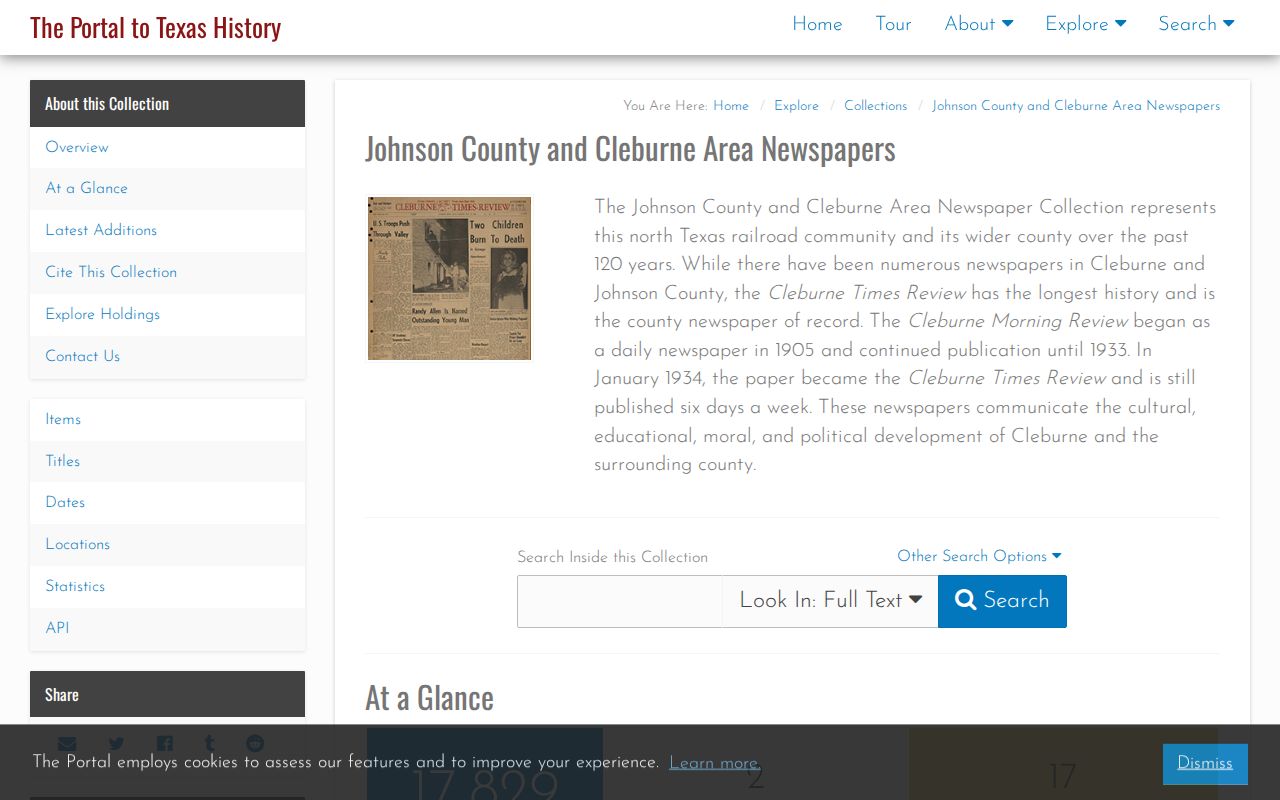
Use the collection’s page image to verify any OCR match. A newspaper may add an obituary, legal notice, civic event, or address change, but it should not be used alone to decide who owned a parcel.
A 1958 Cleburne Times-Review page refers to a 1957 Cleburne City Directory and a telephone number for R. S. King. It confirms that a directory was being referenced, not that the newspaper page is a complete copy of that directory.
Johnson County City Directories and Work Clues
Telephone books and directory entries can connect a street to a period, an occupation, or an employer. The Briscoe citation records Cleburne-area telephone issues beginning in July 1908 and continuing, with documented gaps, through 2005. A listing can support an address-era lead, but subscribers could move, share a line, be omitted, or use a business address. Compare the listing to the closest census, newspaper image, and deed record.
Cleburne’s railroad history gives some entries added meaning without turning them into modern claims. The county museum describes a 1922 railroad strike involving nearly 13,000 people and Texas Rangers. The 1899-1900 entries include Santa Fe workers, a conductor, a flour-mill worker, blacksmiths, and a bricklayer. Occupation and employer terms can therefore be useful alternate searches when an abbreviated surname does not surface.
- 1899-1900: local society transcription preserves a Cleburne directory section with residence and boarding notation.
- 1908 onward: the Briscoe catalog begins its documented Cleburne-area telephone run.
- 1921, 1938, 1947: the Texas State Library verifies these Cleburne shelf years.
- 1918-1990 project range: the Historical Collective digitization work supplies newspaper context, while some microfilm remains undigitized.
Tracing Johnson County City Directory Households
Use city directories as a dated sequence. Start with the closest documented year, write down the entry exactly, and then test the same person in nearby sources. The federal census is generally public through 1950 under the 72-year rule and can add household relationship and age context. A deed should be checked separately because an occupant, boarder, or telephone subscriber may not be the parcel owner.
- Search the surname, initials, street, intersection, and employer terms in the closest available city directory or newspaper collection.
- Record the spelling, exact address, occupation, and whether the entry says res or bds.
- Bracket that year with a census and compare the address, age, and household details.
- Search the digitized papers for notices, obituaries, legal notices, and address changes, then inspect the page image.
- Use the County Clerk deed index separately to distinguish a historical occupant from a purchaser or seller.
- Test old street names and numbering against plats, maps, and the 1898 Sanborn sheets before deciding the household vanished.
- Close the trail with probate, a cemetery office inquiry, a funeral notice, or a later deed, without treating a final listing as a death date.
For a current address-keyed ownership trail, use the Johnson County street directory. The historical volumes here are best used to place a household in time, then verify that finding with the record keeper.
Johnson County City Directory Search Scale
The UNT Johnson County collection supplies a useful measure of what sits beside the printed city-directory shelf: 17,829 items in 17 titles across 16 decades. The Cleburne Times-Review contributes 14,404 of those items and the Morning Review contributes 2,692, with smaller Alvarado, Grandview, and Cleburne titles filling out the collection. A city directory search should therefore include a title search when the address, employer, or surname does not appear in the first paper checked.
That breadth is valuable, but it does not make OCR final. Search with initials, street intersections, and employer terms, then inspect the page image. A newspaper reference can date an address or point to a fuller record, while the city directory remains the source that supplies the structured entry format for its own year.
Johnson County Directory Gaps and Maps
When a city directory shelf has a gap, use the fallback chain rather than guessing. The State Library’s Johnson County finding aid documents missing and stolen historical record volumes, and the library archive reports undigitized microfilm. Request a catalog check from the library, consult the State Library finding aid, and ask the Historical Commission about non-digitized holdings. The County Clerk and Texas Public Information Act process are appropriate routes for public records that are held but not posted online, subject to statutory exemptions.
The library, archive, and records office each solve a different access problem. Ask the Cleburne library whether a desired year is on shelf, microfilm, or in a partner collection. Search UNT first when the issue may be digitized, then retain the title, date, and page number for a librarian or museum contact. The Historical Commission collection reports 452 items across six collections, including newspapers, photographs, books, clippings, pamphlets, and yearbooks, with a date span from the 1860s into the 2010s. That digital subset is useful, but it is not a promise that every local paper or directory is online.
The June 1898 Cleburne Sanborn map set has 11 sheets and can help reconcile structures, streets, lots, and uses. The 1887 Johnson County land-ownership map adds a different geography: named landholders and tracts. Neither map is a current parcel record, and neither resolves a name without supporting documents.
Note: A directory, phone listing, or res notation is historical address evidence, not proof of ownership, kinship, or a person’s current location.